
Sustainable architecture isn’t about expensive technology or complex systems — it begins with decisions made on the drawing board. Passive design strategies use the natural forces of sun, wind, and water to create buildings that consume less, perform better, and last longer. Here are five foundational strategies every architect should be designing with.
Building Orientation
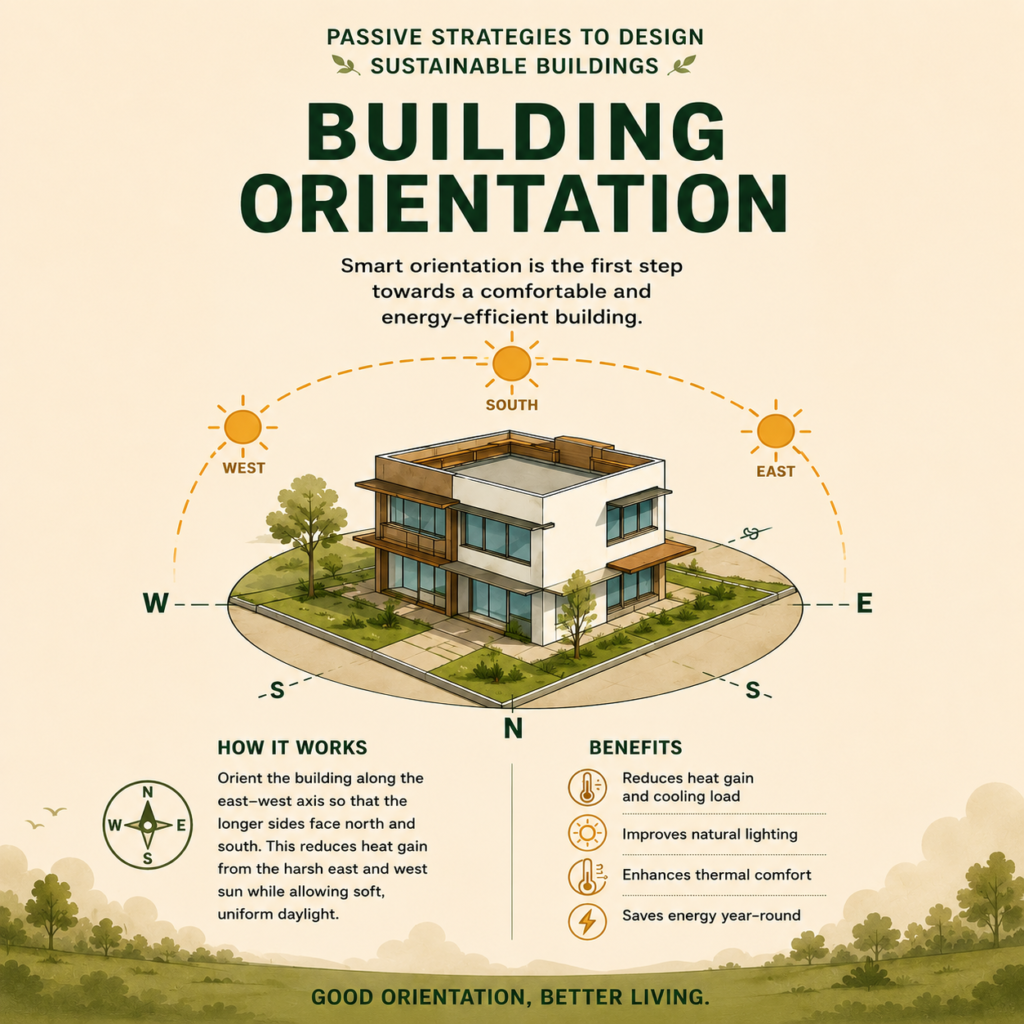
The way a building faces the sun is one of the most fundamental — and most overlooked — decisions in sustainable design. Get the orientation right, and you’ve already reduced your energy load before a single fixture is installed.
In India’s climate, buildings should ideally be oriented along the east-west axis, with the longer façade facing north and south. This minimises direct heat gain from the harsh western sun while allowing diffused, gentler northern light to illuminate interiors naturally. South-facing glass, paired with deep overhangs, captures winter warmth while blocking the high summer sun.
A poorly oriented building fights its own climate. It overheats. It demands mechanical cooling. It consumes. A well-oriented building works with the sun — reducing glare, cutting HVAC loads by up to 30%, and creating spaces that feel naturally comfortable throughout the day.
Orientation isn’t just an energy strategy. It’s a design philosophy. Every degree of rotation is a decision about how a building will live in its environment — and how its occupants will live inside it.
_____________________________________________________________________________________________________________________________________________
Cross Ventilation
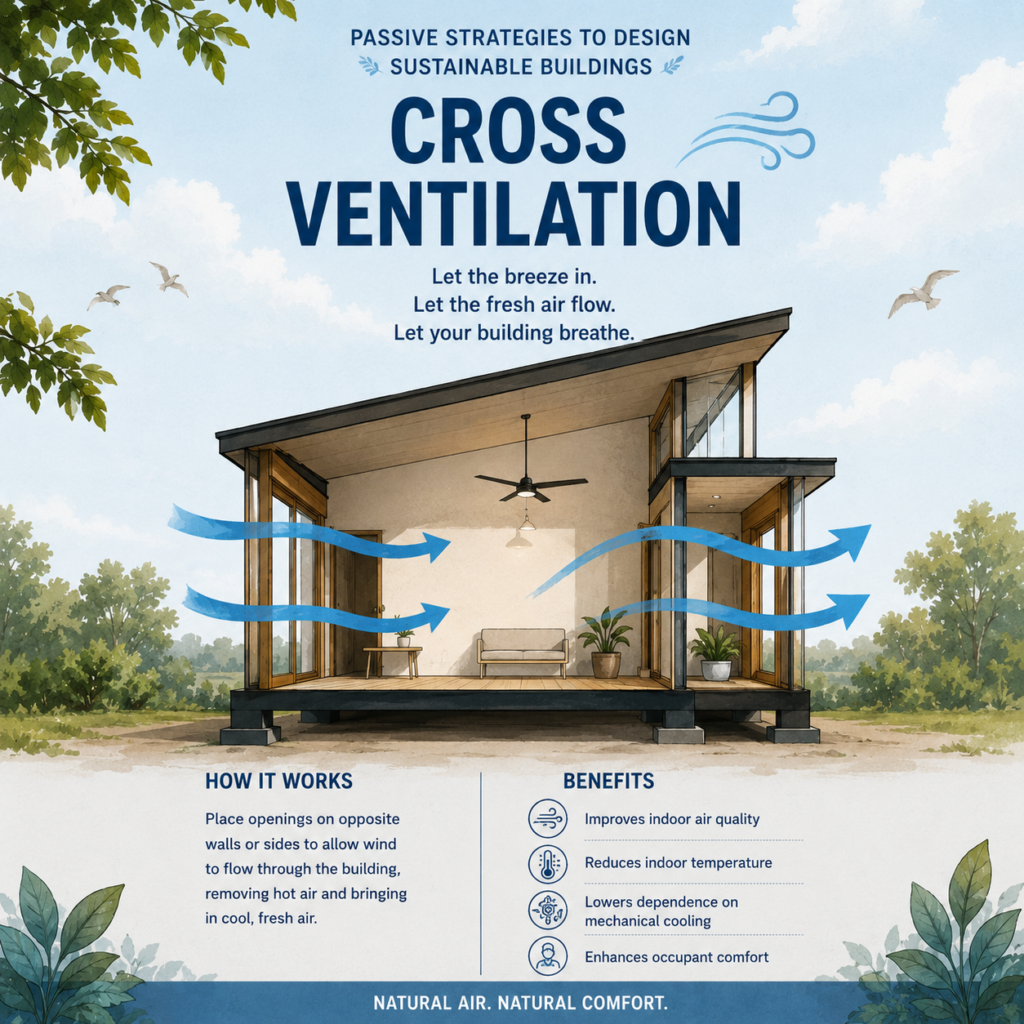
Air conditioning is the lazy answer. Cross ventilation is the intelligent one.
Cross ventilation works by placing openings — windows, vents, louvers — on opposite or adjacent walls so that prevailing winds create a natural airflow path through the building. Hot air exits as cooler air enters, regulating indoor temperature without any mechanical intervention.
The design requires deliberate thought: understanding site wind direction, staggering openings at different heights to create pressure differentials, and using internal layouts that don’t block airflow. Narrow floorplates, open corridors, and strategically placed courtyards all assist the movement of air through a structure.
In India, where monsoon winds are predictable and often strong, cross ventilation is a historically proven strategy — seen in everything from Rajasthani havelis to Kerala’s traditional nalukettu homes. Contemporary architecture is simply rediscovering what vernacular builders knew intuitively.
A building that breathes well doesn’t just save energy. It creates healthier, more pleasant spaces where occupants genuinely feel the difference.
_____________________________________________________________________________________________________________________________________________
Rainwater Harvesting
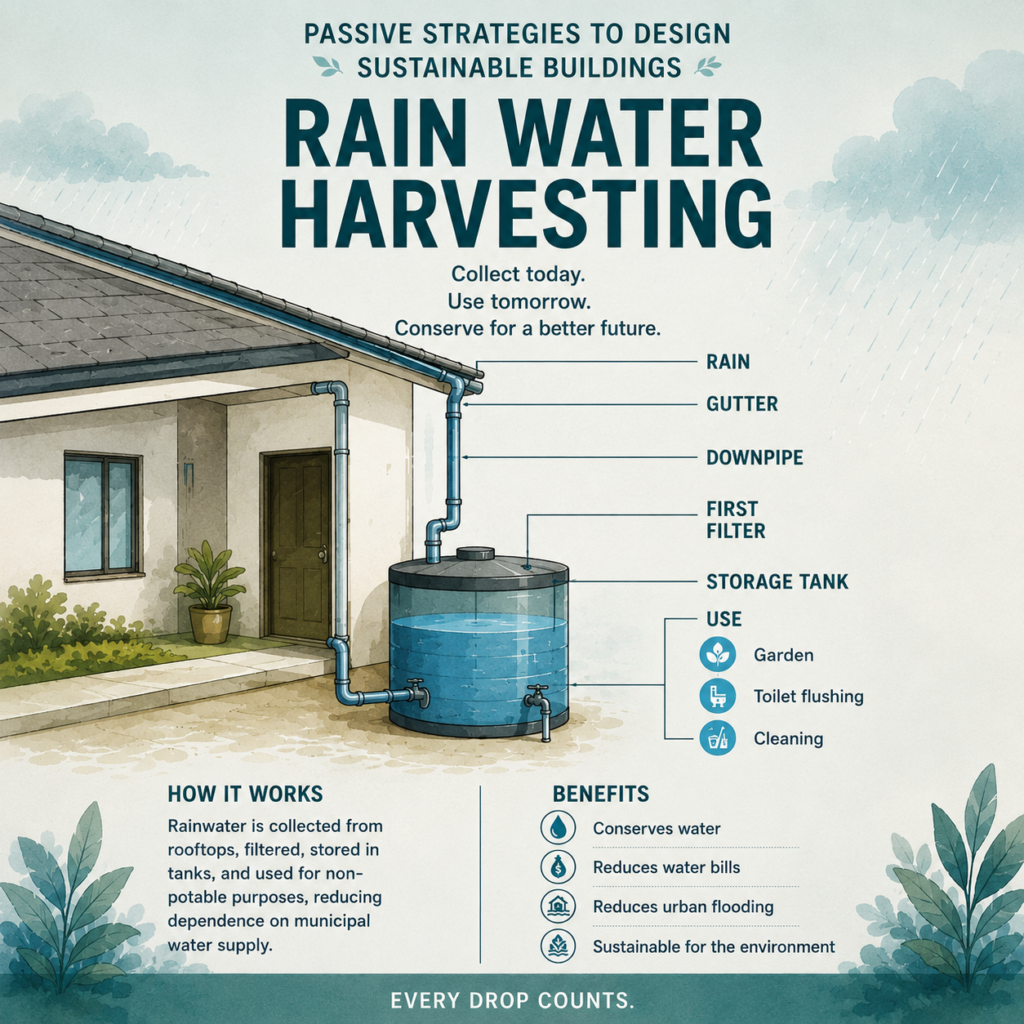
Water scarcity is no longer a future problem in Indian cities. It is a present, escalating reality. Rainwater harvesting is one of the most direct ways architecture can respond to it.
The concept is straightforward: capture rainfall from rooftops and hard surfaces, filter it, and either store it for non-potable use or allow it to recharge the groundwater table. A well-designed system can meet 30–50% of a building’s non-drinking water needs — toilets, landscaping, cooling towers — entirely from collected rainfall.
In sustainable architecture, harvesting is integrated at the design stage, not added as an afterthought. Roof slopes are calculated for drainage efficiency. Collection pipes are concealed within the structure. Storage tanks are sized against annual rainfall data for the specific site. Filter chambers are designed to be accessible for maintenance.
Beyond individual buildings, widespread adoption changes the water table of entire neighbourhoods. Buildings stop being passive consumers of a stressed municipal supply and become active contributors to the urban water cycle.
It is, quite simply, one of the highest-return passive strategies available to any architect serious about sustainability.
Courtyard Planning
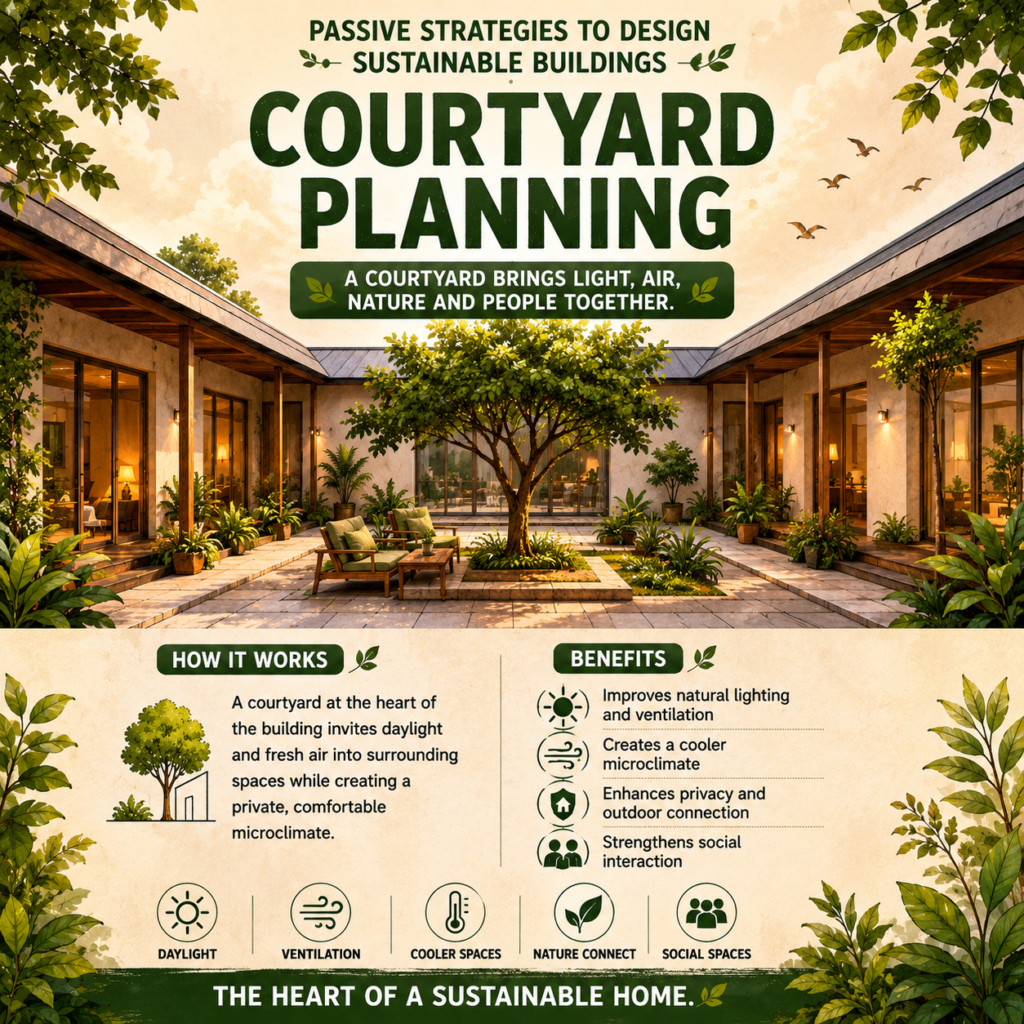
The courtyard is one of architecture’s oldest inventions — and one of its most effective passive cooling tools.
An internal courtyard works as a thermal buffer. During the day, its shaded walls and water features (where present) stay cool. At night, the courtyard radiates heat upward and away from the building, drawing cooler night air inward through surrounding rooms. This stack effect — hot air rising out, cool air drawn in — is entirely self-regulating.
Beyond thermal performance, courtyard planning creates a zone of transition between outside and inside — a semi-private space that belongs to the building’s occupants but connects them to sky, rain, and natural light. In dense urban conditions, it provides greenery and breathing room that would otherwise be absent.
Indian architecture has understood this for millennia. The courtyards of Mughal palaces, Chettinad homes, and walled havelis weren’t aesthetic choices — they were climate strategies embedded in cultural form.
Contemporary architects who return to the courtyard aren’t imitating the past. They’re applying a proven passive technology to a present problem — and creating buildings that are richer for it.
_____________________________________________________________________________________________________________________________________________
Green Roof Designs

A green roof is exactly what it sounds like — a roof covered with vegetation, growing medium, and a layered waterproofing system. But what it does is far more sophisticated than how it looks.
Thermally, a green roof acts as insulation. The soil and plant layer absorbs solar radiation that would otherwise heat a bare concrete or metal roof, reducing heat transfer into the floors below. Studies show green roofs can lower rooftop surface temperatures by 30–40°C compared to conventional roofs — dramatically cutting cooling loads in the occupied spaces beneath.
Hydrologically, they retain 50–90% of rainfall, releasing it slowly rather than flooding drainage systems in a sudden downpour. In cities already struggling with stormwater infrastructure, this is a meaningful contribution at scale.
Ecologically, they create micro-habitats for birds, insects, and pollinators in environments where natural cover has been largely eliminated by construction.
And aesthetically, a green roof transforms dead, wasted space into a living surface — visible from neighbouring buildings, enjoyed by building users, and genuinely contributing to the urban environment rather than detracting from it.
When designed properly, a green roof isn’t a luxury addition. It is a passive system that pays for itself — in energy saved, water managed, and a building that simply performs better over its lifetime.
_______________________________________________________________________________________________________________________________________________________
The Future Belongs to Buildings That Think
Passive design is not a compromise — it is a choice to build smarter. When a building is oriented correctly, breathes naturally, harvests its own water, plans around a courtyard, and grows on its own roof, it stops being just a structure. It becomes a system — one that works quietly, efficiently, and intelligently for the people inside it and the environment around it.
The best sustainable buildings don’t announce themselves. They simply perform — year after year, without excess energy, without waste, and without apology.
That is the standard worth building to.
_____________________________________________________________________________________________________________________________________________